TL;DR
- Wild Forest’s Premium Survival Mode now directly rewards players with $WF tokens.
- The Wild Pass acts as a yield multiplier, costing $WF but offering higher returns.
- Staking and referral programs provide passive income from in-game transaction fees.
Wild Forest has transformed its gameplay into a revenue stream by enabling direct $WF token rewards through Premium Survival Mode and enhancing earnings via the Wild Pass system. This update connects boss wave lootboxes and difficulty levels to token rewards, while the Premium Wild Pass and staking mechanics work together to increase yield and reduce circulating supply.
How Players Can Earn $WF Through Premium Survival Mode
Premium Survival Mode now directly rewards players with $WF tokens inside lootboxes that drop after defeating boss encounters. The mode features four sequential difficulty levels—Easy, Normal, Hard, and Expert—with every fifth wave culminating in a boss battle that awards a scaled lootbox. The contents of these lootboxes increase with difficulty level and can include various resources, Units, and cosmetic Skins.
This design transforms progression and deck building into strategic considerations for players focused on token accumulation. Lootboxes obtained in Survival mode can strengthen a player’s ability to compete in ranked PvP, where weekly $WF prizes are distributed to top performers, creating a feedback loop connecting PvE effort to competitive rewards.
The Wild Pass functions as a multiplier for $WF acquisition by adding rewards on top of routine PvE progression. The Premium track typically costs 1,800 $WF but can yield three to four times that value when fully completed, providing extra Gold, Wild Shards, NFT Units, and exclusive Skins.
Many of these NFTs can be minted and traded on the Ronin Marketplace for $RON, which can then be converted back to $WF or reinvested in the ecosystem.
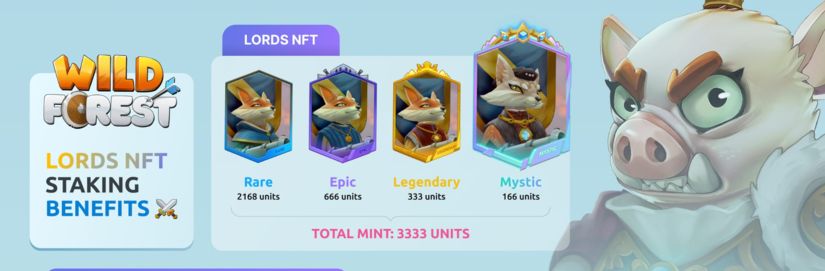
The protocol also offers passive income through staking and revenue-sharing programs. Staking in the Wild Token Pool gives holders a daily share of in-game transactions, with Lord NFT holders receiving an enhanced 30% portion of the pool—potentially representing up to 4.5% of all $WF spent in the game.
Additionally, the Token Share Program redistributes 15% of every in-game transaction back to players through multi-level referral rewards.
Regarding supply dynamics, the ecosystem includes deliberate deflationary mechanisms: a total supply of 1,000,000,000 $WF, a reported 25.58% annual deflation rate, 5,000,000 $WF already burned, and 40,000,000 $WF currently staked.
This combination of burns and intentional sinks aims to connect player activity with scarcity, which has implications for treasuries and market makers assessing long-term supply pressure.
For traders and treasuries, the system presents both yield opportunities and concentration risks. The Wild Pass offers measurable ROI if completed, but acquisition costs and completion requirements affect execution.
Large holders of Lord NFTs concentrate revenue-share flows and could influence token circulation. Liquidity routes—including NFT-to-$RON conversions and staking withdrawal characteristics—should be evaluated before determining exposure levels.
The integration of direct $WF rewards in Premium Survival Mode and the amplifying mechanisms of the Wild Pass convert gameplay into a structured token economy, supported by staking and deflationary mechanics.
The next milestone to watch is the realization of Premium Wild Pass cycles and the weekly PvP payout schedule, which will reveal how theoretical returns translate into on-chain flows and marketable supply.